45 degree drawing 2d vs 3d
Drawing 3D: Axonometry
Goals
Although information technology is possible to directly output axonometric drawing from a 3D model, we still need to know the basic knowledge of its principles. The aim of this folio is to introduce the bones types and drawing steps of axonometric drawing.
Content in a nutshell
- Axonometric is an orthogonal projection used to create a projection of an object on a certain plane. Unlike top, left/right side, or forepart/back view, the object rotates around its one or more than axes to display multiple sides, presenting a three-dimensional event. Axonometry is parallel projection.
- To draw the thirty-30 degree axonometry, the lengths of the lines on the 10, y, and z axis are all drawn to be equal to the actual length. But in reality, axno_x = 0.82 orginal_x; axno_y = 0.82 orginal_y; axno_z = 0.82 orginal_z.
- To draw the 45-45 degree axonometry, the lengths of the lines on the x, y, and z centrality are all fatigued to be equal to the actual length. Simply in reality, axno_x = 0.82 orginal_x; axno_y = 0.82 orginal_y; axno_z = 0.5 orginal_z.
- To depict the thirty-60 degree axonometry, the lengths of the lines on the 10, y, and z axis are all drawn to exist equal to the actual length. But in reality, axno_x = orginal_x; axno_y = orginal_y; axno_z = 0.5 orginal_z.
Types of axonometry
The axonometric cartoon shows the shape of the object on the three coordinate planes. 2D cartoon method is used to express the object in 3D. Distinct from perspective, as a parallel project, there is no distortion along the axis, thus it expresses the shape of the object and details more accurately.
There are many different ways of drawing axonometric drawing, which can express very detailed content equally well as the overall human relationship. But the basic drawing principles are the same, the further content and style are quite personal and need plenty time for elaboration.

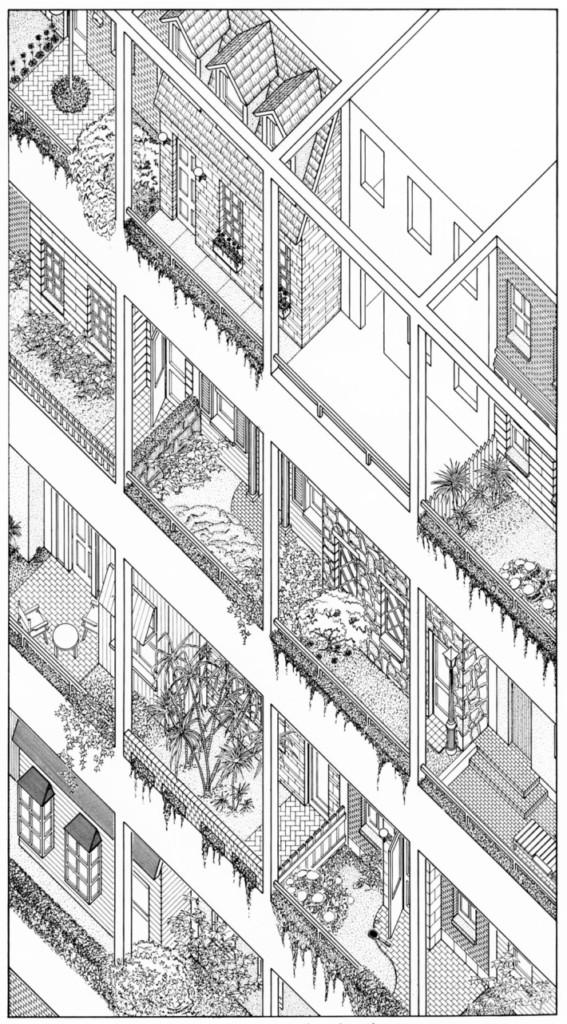
This Axonometric shows the item of a specific role of the edifice. Flick: James Wines, High-rise of Homes.
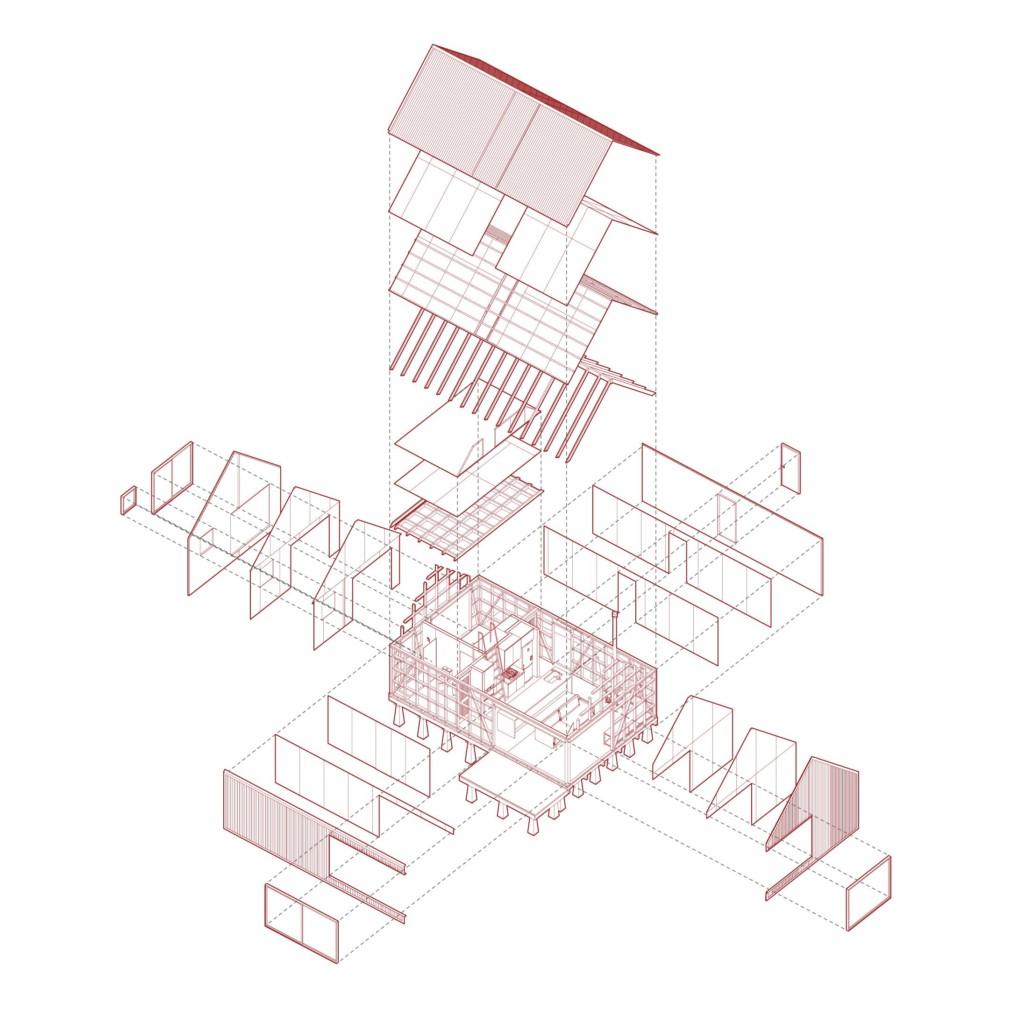
An exploded view of a building. Shows the component of the building. Picture: uploaded by Ignacio Pizarro in Pinterest.

Employ the axonometric technique to draw the building detail. Picture: Stephane De Weck.
To describe a building axonometry, choose outset the type of projection you lot want to apply.
Isometric (30-xxx degree) uses the same scale for every centrality, resulting in a non-distorted image. Also, it is the well-nigh recognizable angle for homo optics.
Oblique projection(45-45 degree) is a type of oblique project where distances and angles are preserved in program and heights are extruded in a vertical management. Since the 10-axis and y-axis are perpendicular to each other, they can be drawn by direct adding tiptop lines to a plane that rotated 45 degrees. Information technology is easy to draw when ignoring the scaling factors.
30-60 degree axonometric also keeps the ten-centrality and y-axis perpendicularly to each other. In addition, information technology maintains the origin length on the x-centrality and y-axis, when taking the scaling factor into account, information technology is easy to draw.
Construction of a drawing in axonometric projection gain in the same way as in traditional drafting on paper. The final drawing is in fact ii-dimensional, with an illusion of three-dimensionality coming from projection qualities of the drawing too every bit from choice of shading of surfaces.
The option of which axonometric to draw depends on the view to be observed. Sometimes it is much faster to construct an axonometric cartoon direct in 2D than modeling information technology offset in 3D.
The most common angle of architectural axonometry is 45-45 degree and 30- threescore degree.
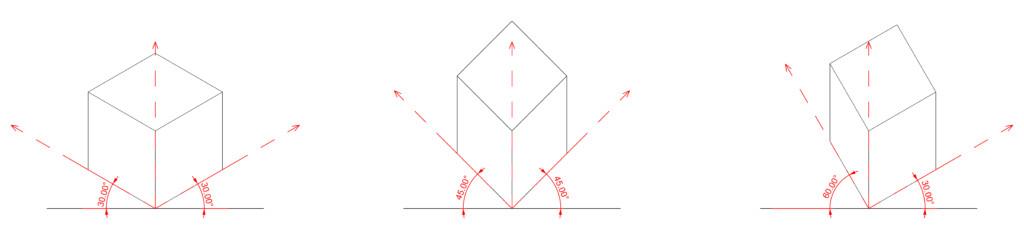
Left: isometric(thirty-thirty caste); Middle: military(45-45 degree); Right: 30-60 degree. Picture: Fanyi Jin
30-30 Caste (Isometric project)
1. Depict a horizontal line, then draw the centrality of xxx-30 degree axonometry.
2. Draw the plan along the centrality, axonometry_x = original_x; axonometry_y = orginal_y.
3. You lot can describe circles to assistance with the measurement.
4. Draw the acme line on z-direction, axonometry_z = original_z.
5. Draw the surfaces.
half dozen. Analyse the occlusion between faces and brand proper deletions.
7. Add details such every bit window frames.
The axonometric can be drawn every bit exploded view to show more than details.
The workflow is shown in the pictures beneath.
Movie: Fanyi Jin
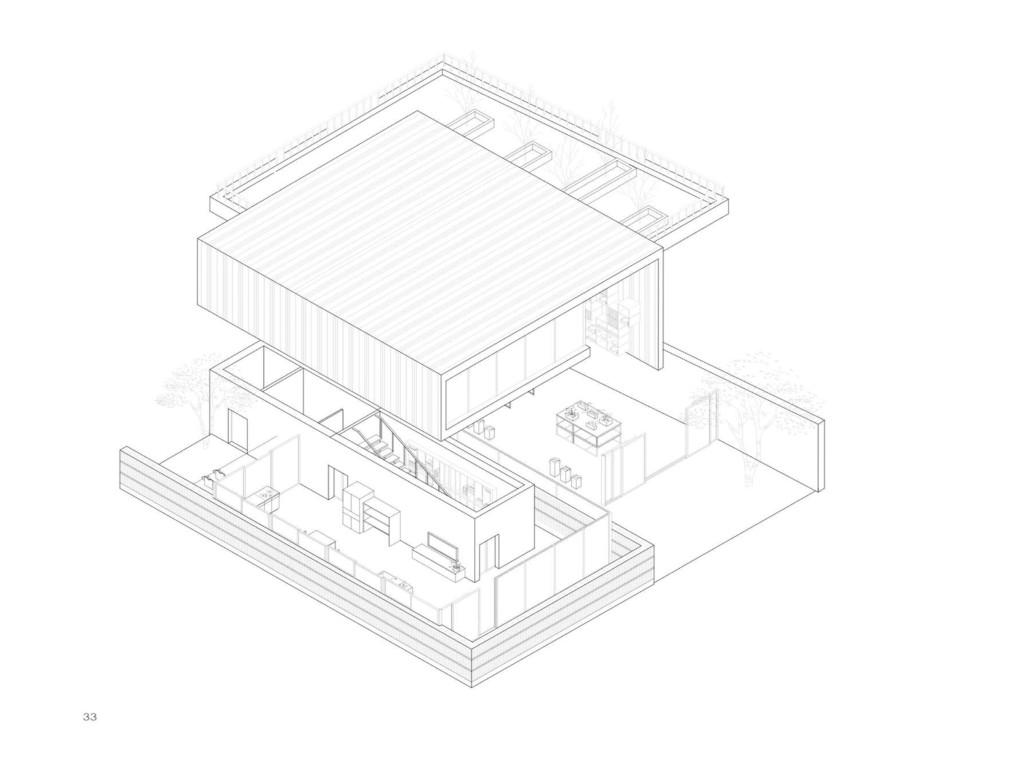
Vertical explode shows more details of the get-go floor and deconstructs the basic shape of the building. Picture: Fanyi Jin
45-45 Degree (military projection)
one. Draw a horizontal line, so draw the axis of 45-45 degree axonometry.
2. Draw the programme on the centrality, axonometry_x = original_x; axonometry_y = orginal_y. You can rotate the plan by 45 degrees to become the issue.
3. Draw the superlative line on z-direction, axonometry_z = original_z.
4. Draw faces and analyze the apoplexy between faces, then make proper deletions.
5. Similar to isometric drawings, you tin apply 45-45 degree axonometric to describe exploded views to show more than details.
The workflow is shown in the post-obit pictures.(The cartoon of adding details is omitted here because the technique is the same.)
Motion-picture show: Fanyi Jin
30-60 Degree
1. Draw a horizontal line, then describe the axis of 30-60 caste axonometry.
2. Draw the program on the axis, axonometry_x = original_x; axonometry_y = orginal_y. Rotate the plan 60 degrees to get the outcome.
three. Draw the height, axonometry_z = orginal_z.
iv. Draw faces and analyze the apoplexy betwixt faces, and then make proper deletions.
five. Similar to isometric drawings, we can use 30-threescore caste axonometric to draw exploded views to show more than details.
The workflow is shown in the following pictures.(The drawing of adding details is omitted here because the technique is the same.)
Motion-picture show: Fanyi Jin
Capacity
Results for {phrase} ({results_count} of {results_count_total})
Displaying {results_count} results of {results_count_total}
Source: https://digitaldesign.aalto.fi/digital-design-workflows/vector/2d-cad-drafting/drawing-3d-axonometry/
0 Response to "45 degree drawing 2d vs 3d"
Enviar um comentário