Great Masterpiece of Gothic Art and Is Admired for Its Proportions Unity of Its Design
Although piddling known and off the beaten tracks, Bourges Cathedral is worth a visit. The Cathedral Saint-Etienne of Bourges was built in record time between 1195 and the late 13th century. Nowadays visitors come to Bourges to adore this stunning and stylistically daring sanctuary. Its proportions and the unity of its pattern make it a "grande cathédrale". In 1992 UNESCO listed Bourges Cathedral every bit a Globe Heritage Site. Follow the guide!
The outset sight of Bourges Cathedral
Bourges Cathedral is a stunning Gothic edifice. Yous'll understand why when standing in two specific spots:
- In front of the Due west façade from identify Etienne Dolet – only look at the incredible width of the façade with no less than 5 portals!
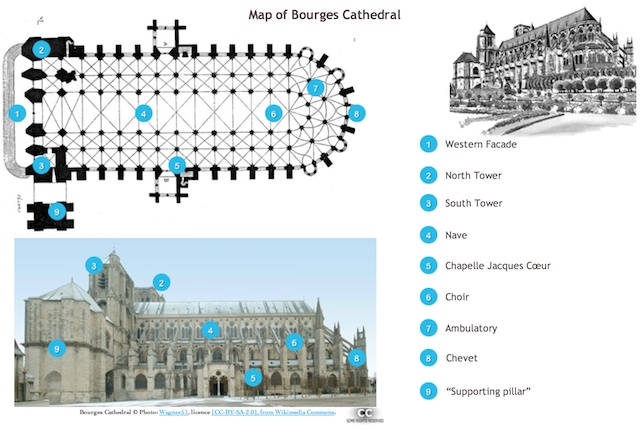
- From the Jardin de 50'Archevêché – adore the astonishing successive of flying buttresses and the chevet. And, surprisingly, at that place's no transept in contrast to other g Gothic cathedrals of France. The magnificent chevet resembles the one at Notre-Dame Cathedral in Paris with double flying buttresses creating an overall pyramid-shaped height.
Information technology is, nonetheless, also its splendid stained-glass windows that similar those at Chartres make this cathedral famous. And for this, you'll take to have a peek inside!
Facts and Figures:
The post-obit facts and figures show why Saint-Etienne de Bourges ranks among the most beautiful Gothic cathedrals of France.
- Total length: 125 m (Reims: 149.nineteen m, Amiens: 145 g, Notre-Dame de Paris: 130 m)
- Length of the West front:55 m or 73.45 m including the 'buttress-pillar' (Rouen: 61.60, Reims: 48.80 m)
- Height of nave: 37.fifteen 1000 (Beauvais: 48 k, Amiens: 42 yard, Metz: 41.7 m. Reims: 38 thou)
- Towers height:65 thousand and 53 thou (Strasbourg: 142 thousand, Orléans: 88 one thousand, Rouen: 82 and 75 m, Reims: 81.50 chiliad)
- Full flooring area: five,900 m2 (Amiens: vii,700 m2, Reims: half dozen,640 m2)
- Diameter of the W front rose window: 9 m (thirteen.1 m for the transept roses in ND de Paris, 12.5 m in Reims)
History of Saint-Etienne Cathedral
The great unity of style of the cathedral St Etienne of Bourges is due to rapid structure. Indeed information technology took less than a century to build!
The political context of the fourth dimension at the cathedral's foundation

The structure of the current cathedral started when Henri de Sully, archbishop of Bourges, made a donation.
The new construction was intended to replace the old Romanesque building (11th and 12th C). The quondam sanctuary became style also small for the city of Bourges. The new classic Gothic-style cathedral was the 4th sanctuary built on the site.
Bourges, a French possession from 1100
In 1100, Bourges and its region became the property of the Rex of France. Information technology and then formed the southern boundary of the kingdom. In fact, the urban center was shut to Aquitaine, an English domain at the fourth dimension.
Bourges was the capital of a territory that the archbishop wished to rule with the same authority every bit the neighbouring "Primate of Aquitaine". His authority, ofttimes contested, expanded all the fashion to Bordeaux.
The city of Bourges was an of import city in the twelfth century. In 1137 the metropolis saw the coronation of Louis VII. The king of France was also the beginning spouse of Eleanor of Aquitaine.
A one thousand Gothic cathedral in the Southward of the Loire
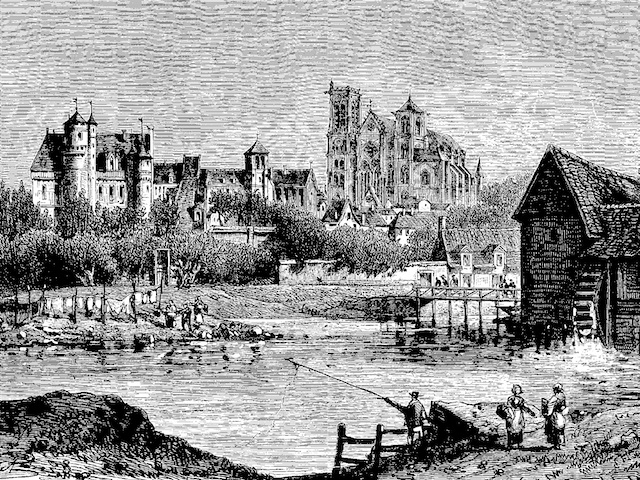
What is unusual near Bourges Cathedral is that it lies S of the Loire. In the fact, it was the showtime grand Gothic sanctuary congenital there. It allowed the rex of France (and too the archbishop) to display his prestige along a geographical border between the northward and south of France.
At the time, you lot would find the most stunning Gothic cathedrals all situated in the Ile de France province. This was the majestic domain, including the cities (and cathedrals of) Reims, Paris, Laon, Chartres, Beauvais, and Amiens. Since and then, Bourges Cathedral has ranked amidst the royal and prestigious French cathedrals… and this has been particularly true in regards to Notre-Dame cathedral in Paris.
The construction of the Cathedral of Bourges
Similar in Amiens, the construction of the new gothic building had to resolve problems related to the old surrounding walls.
Architects integrated the romanesque choir of the previous cathedral into the new edifice. Thus it became the "lower church", buried beneath the chevet due to a difference in ground level. Today, this expanse of the cathedral open to the public is the crypt.
The architects wanted to build a cathedral with a unproblematic but harmonious design. Work on the cathedral began in 1195 and within twenty years, builders completed nearly half of the edifice. Religious services took place in the newly finished choir.
Similarities between Bourges and Notre-Matriarch de Paris
Today it is easy to see the similarities between the cathedrals of Bourges and Notre-Dame de Paris.
Notre-Dame de Paris certainly inspired archbishop Henri de Sully to build Bourges cathedral but he died in 1199 earlier its completion. The side by side archbishop, Guillaume de Dangeon, continued the work up until his decease 10 years after in 1209.

![The Chevet of Bourges Cathedral © Zairon - licence [CC BY-SA 4.0] from Wikimedia Commons](https://frenchmoments.eu/wp-content/uploads/2012/11/Bourges-Cathedral-Chevet-©-Zairon-licence-CC-BY-SA-4.0-from-Wikimedia-Commons-copy.jpg)
The greatest piece of work on the cathedral (the nave and the western façade) was undertaken in 1225 and lasted for 5 years.
In 1313, cracks appeared on the South Tower and information technology began to collapse. Architects quickly strengthened information technology past construction an enormous supporting pillar. The belfry has never sheltered any bells due to the tower'south instability. Hence the nickname of the "Mute Belfry" (Tour Sourde).
No transept for the cathedral of Bourges!
On 13 May 1324, archbishop Guillaume de Brosse consecrated the cathedral. At that time, the façade was yet under construction and then was the North Tower. The architects of Bourges Cathedral are credited with preserving the coherence and simplicity of the unabridged structure. In the notable absence of the transept, they knew how to contribute to the unified style of the monument that is rarely seen in other French cathedrals.
![No transept in Bourges Cathedral © wagner51 - licence [CC BY-SA 2.0 fr] from Wikimedia Commons](https://frenchmoments.eu/wp-content/uploads/2012/11/Bourges-Cathedral-©-wagner51-licence-CC-BY-SA-2.0-fr-from-Wikimedia-Commons.jpg)
During the 15th century
In 1424, André Cassart congenital the famous astronomical clock from a blueprint by Jean Fusoris.
Five years afterward, in 1429, Joan of Arc came to Bourges and prayed in Bourges Cathedral. No one knows if she liked the cathedral, but to this day she is depicted there in one of the chapels wearing armour.
Jacques Cœur and the cathedral of Bourges

Notwithstanding, in the 15th century, the rich and famous Jacques Cœur added to the prestige of the cathedral. This was a way for him to atone for his mistakes and other sins.
To this cease, he used his coin to build a sacristy and, notably, a stained glass window of boggling dazzler. It pushed his son Jean to become archbishop of Bourges at 25 years old!
That time when the Due north Tower collapsed!
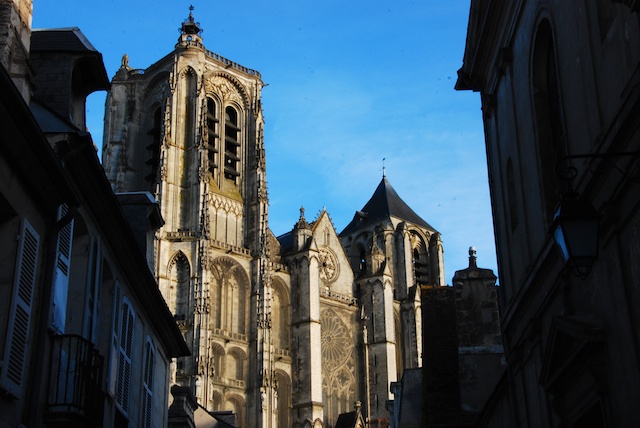
Effectually 1480, workers finally completed the North Belfry. However, it soon showed structural weakness.
And then on 31 December 1506, information technology collapsed. It was necessary to organise funding for its reconstruction. The collapse of the Northward Tower occurred in a detail architectural menses in the French kingdom. Information technology was the Renaissance catamenia. Not far from Bourges, on the lower banks of the Loire, the Kings and his courtroom congenital the most beautiful dwellings of the kingdom of French republic. Prestigious names such as Chambord, Amboise, and Blois.
The Butter Belfry
During the reconstruction of the belfry between 1508 and 1542, the architects took intendance to respect the harmony of the building. They constructed it in a gothic way. Therefore this was a fashion becoming less popular at that time in favour of the Renaissance fashion. Yet they could not resist adding certain decorative flourishes in the Renaissance way.
The construction of the belfry took place thanks to generous donations, loans and various earnings. The highest belfry of the city had to symbolise the power of the authorities, just every bit it did at Strasbourg.
Once it was reconstructed, it took the nickname of the "Butter Tower" (Tour de Beurre). It was widely believed that is was partly paid for by the faithful who were permitted to eat butter and cream during Lent in exchange for tithe. This is similar to another famous "butter tower" at Rouen cathedral.
The cathedral from the Renaissance to the Revolution
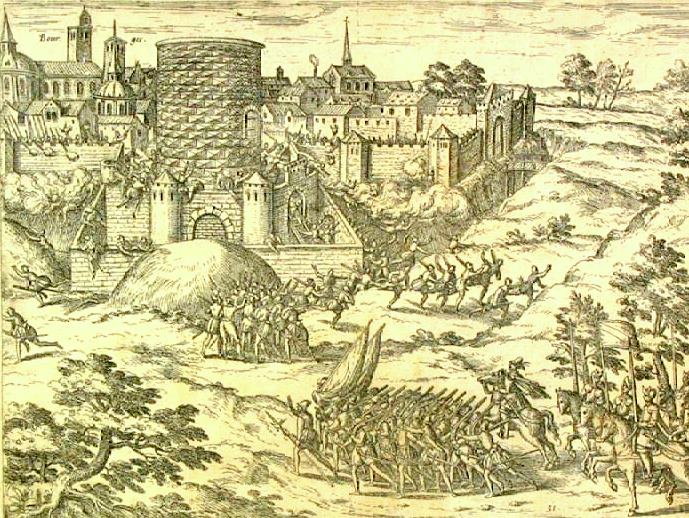
Bourges Cathedral went through the turmoil of the Wars of Religion. In 1562 the town was seized by Protestants who wreaked severe damage on the sculptures.
However, it was the zealous canons of the 18th century that heavily modified the interior of the cathedral in an effort to modernise it. They took away many coloured stained-glass windows in the choir and replaced with clear glass windows.
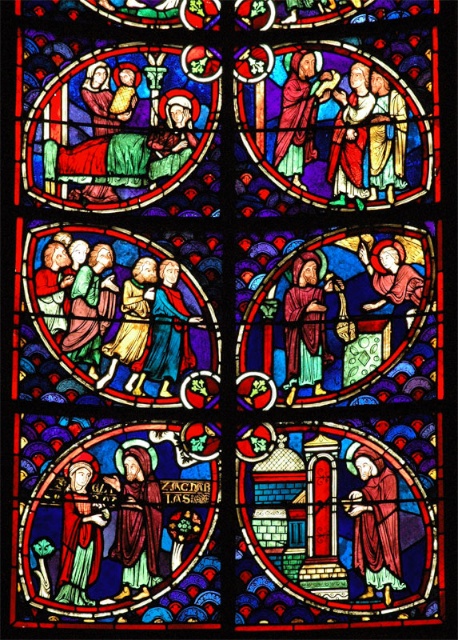
In the nave, they removed the decorated rood-screen with bas-reliefs showing scenes of the Passion.
During the French Revolution, the edifice escaped destruction. As well the dispersal of precious objects and article of furniture, the cathedral was not heavily affected past the Revolutionaries. Under the Reign of Terror (10 December 1793), the new authorities transformed the sanctuary into a Temple of Unity devoted to the Cult of Reason.
The cathedral Saint-Etienne of Bourges in the 19th century
At the beginning of the 19th century, architects added balustrades and pinnacles possibly to imitate Orleans Cathedral.
In 1831, French writer George Sand, so 27 years quondam, wrote to her friend:
"Do yous know your cathedral is i of the most beautiful things in the world? The interior is the nearly impressive that I have seen in my life. I went there for High Mass and I made sounds that would scandalize the faithful… My God, the beautiful columns, the cute vault, the cute stained glass windows…"

Bourges Cathedral became officially a Historical Monument in 1837 and had since undergone intense repairs and restorations. After completing the renovation works on the N, West and Central Portals between 2000 and 2001, the roof was redone in the 2010s.
Thanks to these different phases of renovation, the building that we admire today appear much as it did in the 13th century.
My book recommendation!
Its name? Only:
Gothic: Architecture, Sculpture, Painting past Rolf Toman, Publisher: Ullmann

This book has been for me a peachy resource that helped me ameliorate sympathize the Gothic movement in art from the 12th century to the Renaissance. An architectural way that first originated from France and spread all over Europe.
Over 500 pages information technology focuses on the development of Gothic architecture with many illustrations and photographs, only not just. I've also found interesting the in-depth discussion of the most diverse fine art forms, including painting, sculpture, metalwork and even volume illumination! It also includes specific coverage of the Cathars' Heresy and the Papal Palace in Avignon. And, of course, it mentions the cathedral of Saint-Etienne de Bourges!
This is definitely the book I recommend if – like me – you lot love everything about Gothic such as churches, gargoyles, stained glass, flying buttresses and so much more.
Guild it online!
The exterior of the Cathedral of Bourges
The Western Façade
![The West Front © JPRoche - licence [CC BY-SA 3.0] from Wikimedia Commons](https://frenchmoments.eu/wp-content/uploads/2012/11/Bourges-Cathedral-Facade-©-JPRoche-licence-CC-BY-SA-3.0-from-Wikimedia-Commons.jpg)
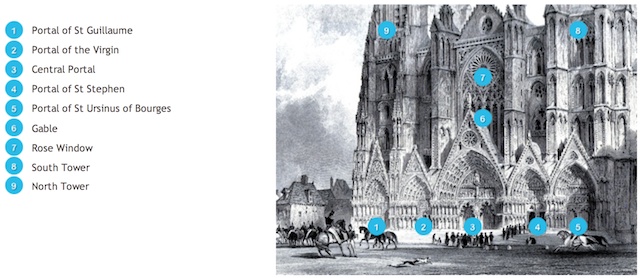
The façade should set up the visitor for the interior of the cathedral. More than 40 meters wide, information technology makes upward the largest western wall of the gothic buildings in French republic. Despite its massive appearance, it nevertheless has many points that lack cohesion.
A flying of 12 steps leads up to the five portals, all with double doors, that stand for exactly to the five naves. The sculptures on the façade are particularly first-class, amongst them the magnificent scene depicting the Concluding Judgement behind the central portal.
Despite the damage done past Protestants and past the French Revolution, there are still 1680 sculptures intact.
Amidst the many bas-reliefs that decorate the façade, on one or two of them, a sculptor has curiously immortalised his derriere!
At ix one thousand wide, the rose window is an impressive delight.
The 5 Portals
From left to right, the facade consists of 6 portals:
The Saint William portal
![The Saint-William Portal © GO69 - licence [CC BY-SA 4.0] from Wikimedia Commons](https://frenchmoments.eu/wp-content/uploads/2012/11/Bourges-Cathedral-Saint-Guillaume-Portal-©-GO69-licence-CC-BY-SA-4.0-from-Wikimedia-Commons.jpg)
Dating from the 16th century, it is dedicated to the archbishop of Bourges who saw its construction. Guillaume was canonised afterward his expiry.
The Virgin'south portal
![The Virgin Portal © GO69 - licence [CC BY-SA 4.0] from Wikimedia Commons](https://frenchmoments.eu/wp-content/uploads/2012/11/Bourges-Cathedral-Virgin-Portal-©-GO69-licence-CC-BY-SA-4.0-from-Wikimedia-Commons.jpg)
It dates from the 16th century.
The central portal or Last Judgement portal
![The Last Judgement Portal © Fab5669 - licence [CC BY-SA 4.0] from Wikimedia Commons](https://frenchmoments.eu/wp-content/uploads/2012/11/Bourges-Cathedral-Last-Judgement-Portal-©-Fab5669-licence-CC-BY-SA-4.0-from-Wikimedia-Commons.jpg)
Information technology is designed on the theme of the Terminal Judgement. This masterpiece of Gothic sculpture dating from the 1240s depicts a grandiose and realistic rendition of the Last Judgement, surveyed by a majestic and beatific Christ.
![The Last Judgement Portal © Codex - licence [CC BY-SA 3.0] from Wikimedia Commons](https://frenchmoments.eu/wp-content/uploads/2012/11/Bourges-Cathedral-Last-Judgement-Portal-©-Codex-licence-CC-BY-SA-3.0-from-Wikimedia-Commons.jpg)
Heaven, inhabited by angels and the chosen, draped in long robes, is opposed by a delineation of hell, swarming with demons and the damned dogged by despair. Amidst this scene is a strikingly cute statue of the Archangel Saint Michael, grinning graciously, which evokes the smiling angel of Reims.
The portal of Saint Stephen
(Portail Saint-Etienne)
As for the unabridged cathedral, information technology owes its name to the first Christian martyr.
The portal of Saint Ursinus of Bourges
![The Saint-Ursinus Portal © GO69 - licence [CC BY-SA 4.0] from Wikimedia Commons](https://frenchmoments.eu/wp-content/uploads/2012/11/Bourges-Cathedral-Saint-Ursin-Portal-©-GO69-licence-CC-BY-SA-4.0-from-Wikimedia-Commons.jpg)
Saint Ursinus was the first bishop of Bourges. He built the town's very first church at the beginning of the Christian era. The bas-relief of this door'due south sculpture tells office of his miraculous story.
The towers of the façade
Two towers, the North Belfry and the South Tower, stand at either side of the façade. Both incomplete, neither tower has a spire, limiting the cathedral's attain into the skyline, unlike its rivals at Chartres or Cologne.
The S Tower
The South tower'due south nickname is "the Mute tower" because it never contains whatsoever bells. A pillar which acts as buttress, support the tower.
![Bourges Cathedral South Tower © Fab5669 - licence [CC BY-SA 4.0] from Wikimedia Commons](https://frenchmoments.eu/wp-content/uploads/2012/11/Bourges-Cathedral-South-Tower-©-Fab5669-licence-CC-BY-SA-4.0-from-Wikimedia-Commons.jpg)
Architects intended to summit the 53 metres high tower with an octagonal spire. The lack of spires is non a problem unique to Bourges. Other cathedrals in France had neither the funding nor the technical chapters to build them atop their towers. This was the case at Notre-Matriarch de Paris, Reims and Amiens.
The North Tower
The North Tower or "Butter Tower" was rebuilt in 1506, taking care to harmonise with the gothic mode of the façade. Church regime funded information technology with money raised from taxing people for eating butter during Lent.
![The North Tower © Fab5669 - licence [CC BY-SA 4.0] from Wikimedia Commons](https://frenchmoments.eu/wp-content/uploads/2012/11/Bourges-Cathedral-North-Tower-©-Fab5669-licence-CC-BY-SA-4.0-from-Wikimedia-Commons.jpg)
The tower is 65 metres in peak and yous can climb to its summit on a 396 step staircase. There is a panoramic view from the meridian looking over the old boondocks of Bourges and, beyond that the countryside of Berry.
A Pelican in Bourges!
A rather curiously weathervane in the form of a pelican tops the cathedral. This is in dissimilarity to other French churches, where 1 would run across either a cockerel or a cross.
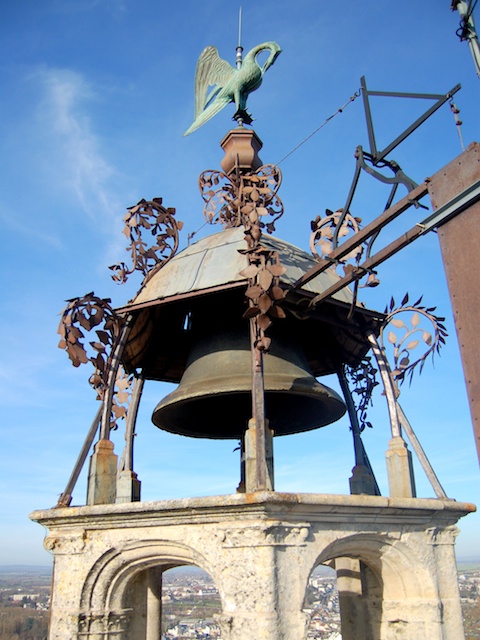
The Pelican of Bourges sits atop the N Tower, on a small construction that holds a bong dating from 1372 – a donation from Duke Jean de Berry.
The 16th-century bronze bird once sabbatum on the spire that rose from the centre of the nave.
![The famous Pelican of Bourges ! © Ji-Elle - licence [CC BY-SA 3.0] from Wikimedia Commons](https://frenchmoments.eu/wp-content/uploads/2012/11/Bourges-Cathedral-Pelican-©-Ji-Elle-licence-CC-BY-SA-3.0-from-Wikimedia-Commons.jpg)
In 1995, a copy replaced the Pelican, and so in poor condition. You'll see the original sitting at the bottom of the Tower.
The Cathedral's Bells
Bourges cathedral has 7 bells, vi of which are still in use.
![Bourges Cathedral © Fab5669 - licence [CC BY-SA 4.0] from Wikimedia Commons](https://frenchmoments.eu/wp-content/uploads/2012/11/Bourges-Cathedral-©-Fab5669-licence-CC-BY-SA-4.0-from-Wikimedia-Commons.jpg)
- The bong donated by Duke Jean de Drupe: sitting at the peak of the North Tower, this is the oldest bell in the cathedral, dating from 1372. The bell can no longer ring as the clapper is missing.
- The Gros Guillaume bell: this is the largest also equally the heaviest bong of the cathedral, weighing more than 6080 kg. It replaced the bell of St. Stephen in 1829, which cracked during the Midnight Mass of Christmas 1838. Several years subsequently, it was recast. To avoid another incident similar to that of 1838, the bong is non much used, except to marker important occasions.
- The Maria-Theresa Bell: currently out of use, the bell dates from 1828, weighs 1830 kilos and measures approximately one.v one thousand across.
In 1933, the Paccard bell foundry in Annecy cast four more than bells for the cathedral: Henri-Zita, Daniel-Mathilde, Célestine-Martine, and Louise.
The magnificent Chevet
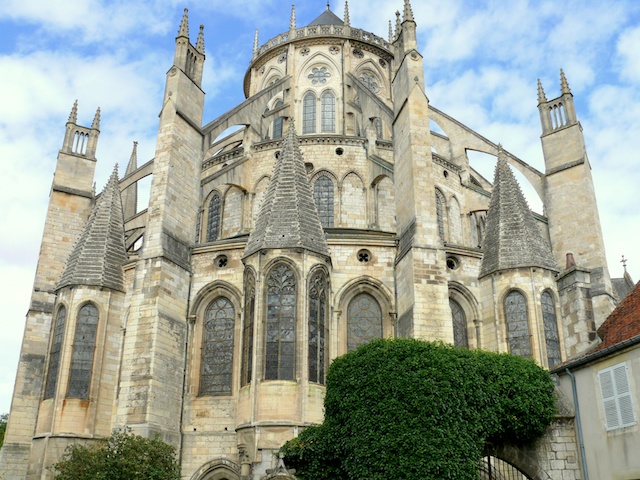
The fantastic double-arched flight buttresses on the exterior of the cathedral are very similar to those of the chevet of Notre-Dame de Paris. This manner of using flight buttresses was used at Chartres.
The missing Transept
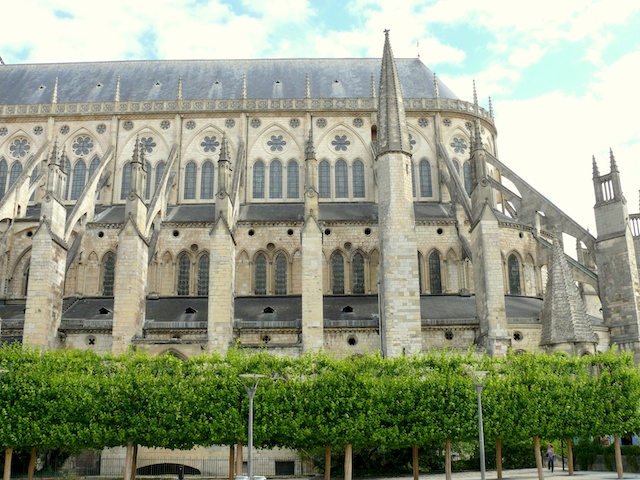
The obvious particularity of the design of Bourges cathedral is the lack of transept. At a time of the great Romanesque style churches (11th-12th centuries), transepts were usual equally they allowed for the sanctuary to take the shape of a cross.
Indeed this was a traditional form that every significant church had to follow. Not long before Bourges, some cathedrals and churches did non have a transept: Vézelay, Sens, Senlis and the collegiate church at Mantes. This exceptional style at Bourges was not widely popular in the Middle Ages. In fact, the cathedral had a imitation transept added betwixt the 14th and 18th centuries.
The interior of the Cathedral of Bourges
With an area covering 5,900 m2, Bourges cathedral surpasses Notre-Dame de Paris (five,500 m2). It is remarkable not only for its lack of transept but as well for its double cardinal aisle. These features allow the company to the cathedral a clear view through it, opposite to other cathedrals (such equally Chartres and Reims) where the transept traditionally cuts across the centre.
The Nave
![The vaults in the nave © MOSSOT - licence [CC BY-SA 3.0] from Wikimedia Commons](https://frenchmoments.eu/wp-content/uploads/2012/11/Bourges-Cathedral-Nave-Vaults-©-MOSSOT-licence-CC-BY-SA-3.0-from-Wikimedia-Commons.jpg)
The nave at Bourges is impressive. The vaulted ceiling in the key hall is 37.12 grand high, more than than that of Notre-Matriarch de Paris (33 one thousand), but lower than the ceiling of Metz cathedral (41.41m), Amiens (42.3 yard) and Beauvais (48.5 g). The overall within height is 21.3m and the outside measures 9m. The width of the central nave measures 14.96 1000.
![The Nave © Zairon - licence [CC BY-SA 4.0] from Wikimedia Commons](https://frenchmoments.eu/wp-content/uploads/2012/11/Bourges-Cathedral-Nave-©-Zairon-licence-CC-BY-SA-4.0-from-Wikimedia-Commons.jpg)
Each of the five naves has attics, arches and windows unique to the building. Six, widely-spaced pillars, 18 metres in height support the construction. They are spaced in such a fashion that larger and relatively smaller pillars are alternated. Walking down the side aisles, you'll find many chapels, many with their original ornamentation.
The Ambulatory
The double convalescent naturally continues the side aisles of the nave.
![Bourges Cathedral Ambulatory © Zairon - licence [CC BY-SA 4.0] from Wikimedia Commons](https://frenchmoments.eu/wp-content/uploads/2012/11/Bourges-Cathedral-Ambulatory-©-Zairon-licence-CC-BY-SA-4.0-from-Wikimedia-Commons.jpg)
Architects did not include the five chapels of the chevet in their initial plans. Therefore, they are quite small in size. They are built on corbelling buttresses that dissever the windows of the crypts.
The Choir
![The choir © Zairon - licence [CC BY-SA 4.0] from Wikimedia Commons](https://frenchmoments.eu/wp-content/uploads/2012/11/Bourges-Cathedral-Choir-©-Zairon-licence-CC-BY-SA-4.0-from-Wikimedia-Commons.jpg)
Carved wooden stalls and a magnificent high altar made of marble ornate the choir.
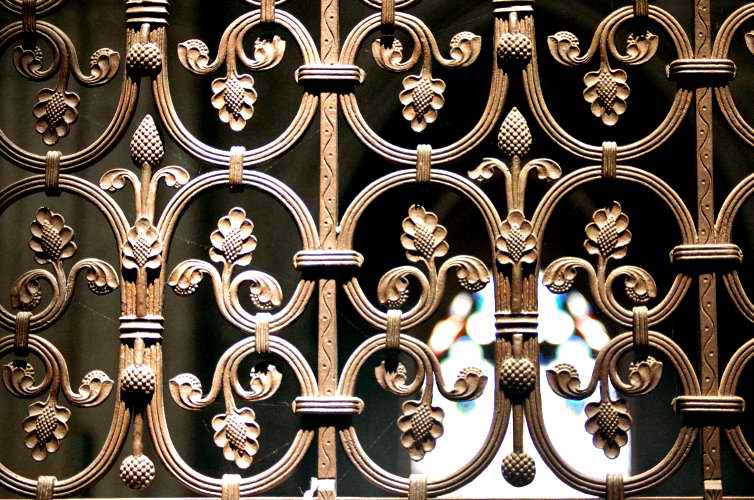
The fantastic stained-glass windows
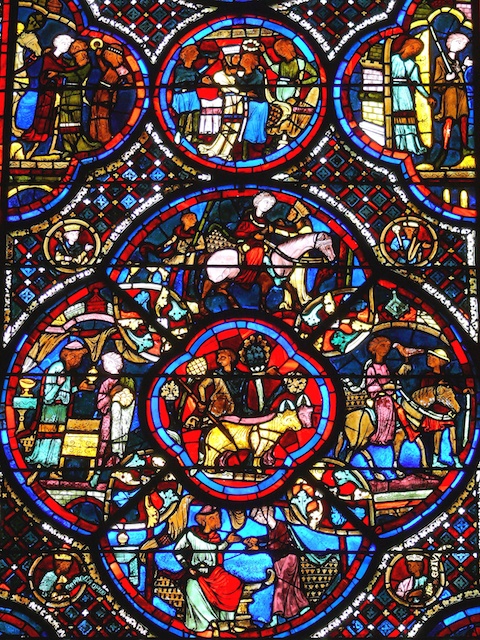
Metz cathedral may take the greatest area of windows in France. But scholars concur that the stained-glass windows of Chartres and Bourges cathedrals are among the nigh beautiful.
In Bourges cathedral lone there are 183 stained-glass windows, almost all dating from the 13th century, and in which more than 2,450 characters appear. The windows that appointment from the early on 13th century, seen throughout the three levels of the choir, are especially colourful. They diffuse the light while assuasive it to pass through in a steady, unbroken stream (lux continua).
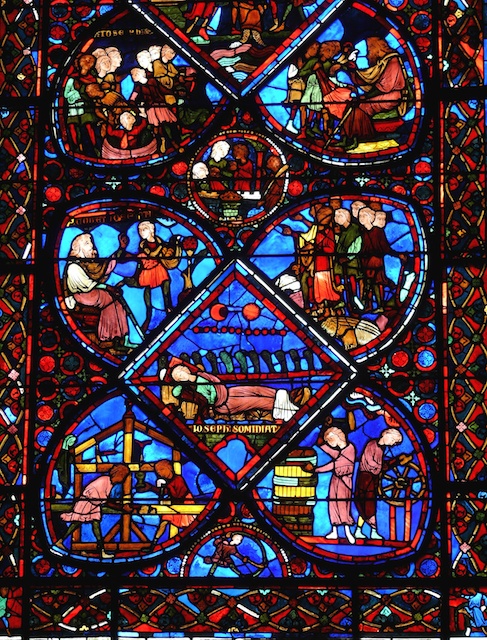
Similar to the fashion of modern comic strips, for the Christians of the Middle Ages, these windows were veritable "books of lite" that illuminated the teachings of the Church.
In the same manner, the windows in Bourges cathedral portray scenes of Terminal Judgement and the Apocalypse, the Virgin Mary and Saint Stephen, the hierarchy of the trade guilds, scenes from the Sometime and New Testaments, the life of the saints and the martyrs, the archbishops of Bourges, the prophets and the apostles.
The guilds would generally pay for such windows.
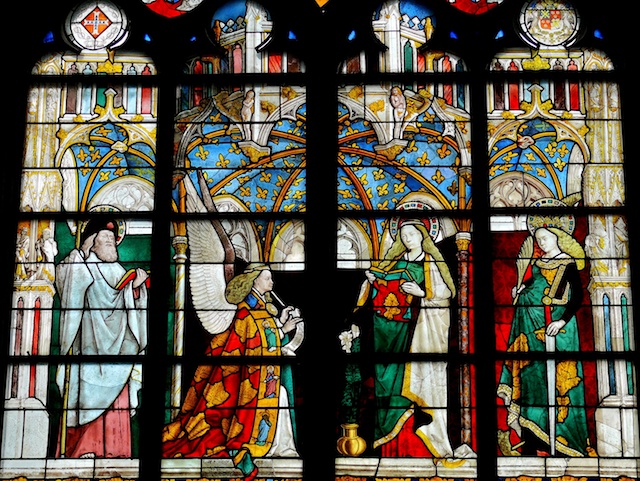
Stained-glass windows also decorate the lateral chapels of the 14th and 17th centuries. In this case, they come from the wealthy class of Bourges. The most famous window amidst these are in the chapel of Jacques Cœur and shows the Proclamation.
The treasure of the Cathedral
The public tin can meet the cathedral's treasure at least once a year, usually during the Heritage days in September.
The treasure consists of liturgical objects made of copper, silvery and gold. The treasure is kept in the cathedral's sacristy built past Jacques Cœur (15th C). It includes the episcopal cross, the pastoral ring, the episcopal crook, the chalice and the paten.
The astronomical clock of Bourges
The Astronomical Clock of Bourges cathedral dates back to 1424. It is the work of canon and mathematician Jean Furosis. The clock consists of a belfry holding two clocks, painted red and decorated with flowers, shields and golden lines.
![The astronomical clock © Zairon - licence [CC BY-SA 4.0] from Wikimedia Commons](https://frenchmoments.eu/wp-content/uploads/2012/11/Bourges-Cathedral-Astronomical-clock-©-Zairon-licence-CC-BY-SA-4.0-from-Wikimedia-Commons.jpg)
The higher clock shows the hours and minutes and dates from the 19th century.
The lower clock is older, dating from 1424 and displays the lunar cycle, the summit of the dominicus and the signs of the zodiac. Until 1757, the clock was placed above the rood-screen, which is no longer there.
The astronomical clock now hangs on the lower southern side of the cathedral, close to the slap-up entry. A re-create of the clock can exist seen at the Tourist Function in Bourges.
The catacomb: one of the largest in France!
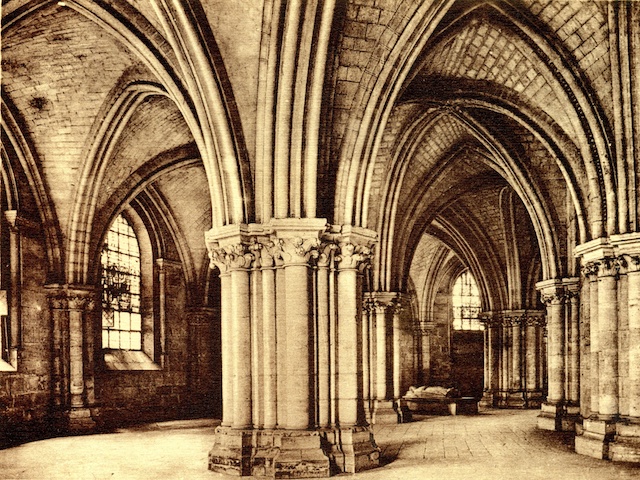
The crypt of Bourges cathedral is amongst the largest in France. It consists of a fundamental chamber with two ambulatories. In fact information technology is a true underground church. Its stained-glass windows come from the Sainte-Chapelle church in Bourges destroyed in 1737.
The crypt is as well abode to diverse objects:
- bang-up sculptures that previously appeared on the cathedral'south façade,
- sepulchre tombs (including the tombs of the Jean 1st, Knuckles of Berry),
- several statues from tombs that used to decorate the church,
- and a large piece of 14th-century sculpture, showing a saint of the sepulchre.
Below the crypt, lies a Romanesque church building, the burying site for the archbishops of Bourges.
More info about the monument!
Here are a few websites and blogs near Bourges Cathedral that y'all might find useful:
- other famous cathedrals on the weblog: Reims, Amiens, Beauvais, Rouen, Metz, Strasbourg, and Notre-Matriarch de Paris.
- the website of the Bourges Berry Tourist Lath
- the site of Centre des Monuments Historiques for climbing to the cathedral'south Towers.
- to book your accommodation in Bourges, click on this chapter link which volition redirect you to our partner booking.com
- Wikipedia's article on Bourges Cathedral
Opening times vary co-ordinate to the flavor of the yr. Generally, the cathedral of Bourges opens every day from 9.30-x am to 5.30-5.45 pm with a lunch suspension between xi.45 am to 2 pm. No visits on Sun morning time during masses. The entrance is free. More info…
Pivot it for later!
Liked what you read? Pin in on Pinterest:

You might want to read these related posts...
Transparency: Some blog posts and pages may contain affiliate or sponsored links. If you are planning a trip, the apply of these links helps us to run the site. At that place is no additional toll to you lot. All yous have to do is click on the link and any booking you make is automatically tracked. Thank you for your support!
Source: https://frenchmoments.eu/bourges-cathedral/
0 Response to "Great Masterpiece of Gothic Art and Is Admired for Its Proportions Unity of Its Design"
Enviar um comentário