Why Hasnt the Great Depression Happened Again
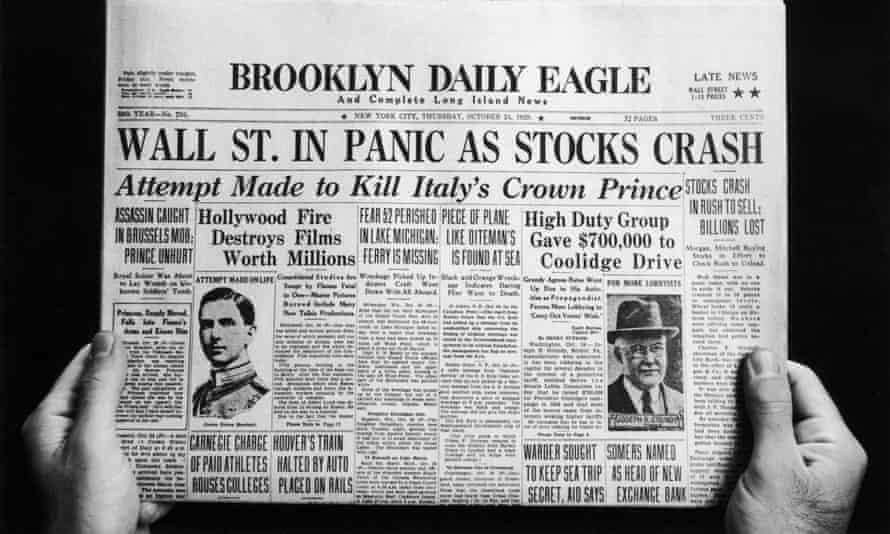
S uch was the scale of the global market place crash last week in the wake of the coronavirus outbreak, the spectre of the 1929 Wall Street rout and the ensuing Great Depression of the 1930s has been raised. Comparisons no longer seem fanciful.
The failure of the United states of america and the UK to swing into activity with a wide range of mitigation measures – despite the lessons of Italia's slow response to the spread of Covid-19 – has heightened concerns that a sustained, epochal downturn lies in look.
And a depression would hateful an virtually exact repeat of the aforementioned period ane hundred years agone, when a deeply divided guild and soaring stock markets during the 1920s gave mode to a tortuously slow render to economic health during the 1930s in the wake of the 1929 stock market place crash.
In the aforementioned style, the 3rd decade of the 21st century could add together another 10 years to the depression that followed the 2008 financial crash.
It took Franklin D Roosevelt'southward huge injection of government funds under the banner of a New Deal to bring the US economy back to growth from 1933. For 3 years, the economy expanded until the Usa cardinal bank intervened in 1937, repeating its mistake of just a few years before to increase involvement rates and trigger another recession.
On 5 March, analysts at Citigroup wrote that the signs were looking grim. "The 5-shape recovery theory has been significantly challenged, equally investors correctly entertain the idea of a far more protracted recovery."
Panicked past a lack of information about the spread of the virus and the stumbling indecision of many governments, stock markets plummeted for a fourth week to fresh lows.
In the Us, the Southward&P 500 index of top U.s.a. companies' shares tumbled back to a level non seen since before Donald Trump gained the presidency. By the heart of concluding week, the other bellwether of US investor sentiment, the Dow Jones industrial boilerplate, was down 30% from its elevation.
Making matters worse, Trump refused to abandon a trade war with Beijing that has kept import tariffs on billions of dollars worth of Chinese appurtenances. With much of Red china and Us manufacturing suffering a plummet in output, it seemed the perfect time for Washington to put aside a battle that had already slowed a global recovery in 2017 to a clamber in 2019.
Across Wall Street predictions of a V-shaped recovery – i that means that past the end of the year a surge in economical activity through the fall has eradicated near of the lost output in the spring and summertime – were ditched in favour of an L-shaped recovery of low growth into the middle distance.
"It is admittedly clear to every unmarried investor," the Citigroup analysts went on, "that the 2019 growth consensus is non going to materialise."
A survey of leading academic economic experts beyond Europe establish that a majority believe a major recession is a likely upshot of the coronavirus pandemic, whatever the death toll.
One of the principal reasons for their gloomy outlook, and for many respondents to say they believed a long depression would follow the recession, was their eye-rolling assessment of Europe's finance ministries and how effective they can be in a crisis. Two-thirds told researchers at Chicago Academy that information technology is "highly doubtful" finance ministries would answer effectively to the potential damage from Covid-19.
On Fri, Rishi Sunak fix out extra measures to protect business from going bust and households from dramatic falls in income. It was the chancellor's tertiary attempt to allay fears that the UK would enter a recession from which it could take years to exit.
Widely seen every bit a way to match the income guarantee schemes implemented by the Scandinavian countries and Austria, Sunak'due south plan followed warnings from the TUC and business groups that his first two efforts had fallen short, leaving hundreds of businesses to lay off workers or go bust.
There are still economic forecasters who predict a speedy return to health and a V-shaped recovery.
In recent days, Oxford Economic science has predicted a deeper recession for the United kingdom than it estimated fifty-fifty a week ago, with a key forecast showing naught growth at the end of the yr downgraded to a 1.4% pass up.
Meanwhile, the global economy gets a downgrade from 2.5% to zero growth for 2020, "which would mark the second-weakest year for the global economy in almost 50 years of comparable data, with only 2009, in the depths of the global financial crisis, being worse", it said.
But the consultancy notwithstanding expects a strong bounce-dorsum in GDP by the middle of next year. With Sunak's latest measures in place, – and just as importantly working well – the UK could return in 2021 with 3.seven% growth.
Dario Perkins, the head of macroeconomics at TS Lombard, says the longer the stop/kickoff reactions to the virus keep, from social distancing to school and pub closures, the longer the recovery is likely to be.
"But governments will have to mount a massive fiscal response. We've already had 10 years of low growth. It will be completely unacceptable to take another 10 years. Nosotros idea the spending taps would open in response to the climate emergency. At present it will demand to happen to tackle the economic consequences of the virus and to salve the planet" he said.
That means a echo of the 1930s, when information technology took the US economy until 1939 to reach the level of GDP seen in the 1920s, may be prevented by a double-barrelled blast of funds from fundamental banks and governments in the next couple of years.
John Llewellyn, a former principal economist at the OECD, who now runs his ain consulting house, is sceptical that governments take the volition to interact to heave growth while tackling climatic change. He fears populist movements will strength many national administrations to retreat further backside protectionist trade barriers, condemning the global economy to further years of low growth.
Tommaso Valletti, head of the department of economics and public policy at Purple College Business organisation School, said: "Looking at the past two centuries, nosotros had many recessions but simply i depression – in 1929 – which lasted almost a decade. So nosotros really take a very limited sample size to draw from history.
"And the Peachy Depression happened with a perfect storm of bad events, including a tightening of monetary policy of the US fundamental bank. Nosotros have learned how to lend support to the economy, and I observe that central banks are doing the right thing at present, with expansionary monetary policies. I remain optimistic that we volition avoid a repetition of the Great Depression: still, there will be massive economical and social costs and longer-term economic restructuring."
Yet while central banks learned the lessons of the 1929 crash, it remains to exist seen if governments have learnt the lesson of the last x years and put thrift behind them.
Then and at present
The Smashing Depression
By 1933, when the Not bad Depression reached its lowest point, some 15 meg Americans (xx% of the population) were unemployed and nearly half the country's banks had failed.
By 1931, industrial product had dropped by one-half, prompting President Herbert Hoover'southward administration to offer declining banks and other institutions regime loans, allowing them to extend loans to businesses, which would hang on to staff. It was widely considered a flop.
President Franklin D Roosevelt'south New Deal prompted three years of 3% boilerplate growth from 1933. This came to an end in 1937 when the Federal Reserve increased involvement rates, sending the economy back into recession.
The 2020 coronavirus outbreak
Jobless claims surged last calendar week to 281,000 – a jump of 70,000 from the week before.
Analysts at Goldman Sachs predict weekly claims volition skyrocket to 2.25 million by this Thursday when the next figures are published.
Rival forecasts for April range from 500,000 to v 1000000.
The worst month for job losses during the financial crisis was 800,000 in March 2009.
Source: https://www.theguardian.com/business/2020/mar/21/100-years-on-another-great-depression-coronavirus-fiscal-response
0 Response to "Why Hasnt the Great Depression Happened Again"
Enviar um comentário